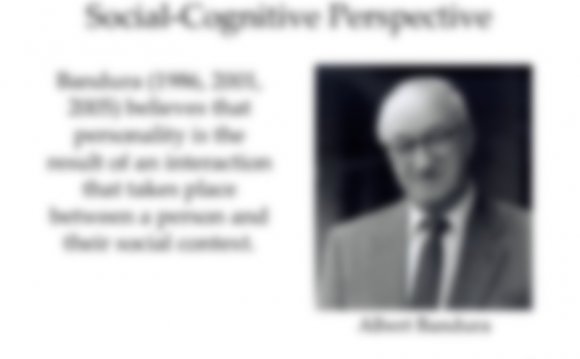
Social cognitive theory (SCT), used in psychology, education, and communication, holds that portions of an individual's knowledge acquisition can be directly related to observing others within the context of social interactions, experiences, and outside media influences. The theory states that when people observe a model performing a behavior and the consequences of that behavior, they remember the sequence of events and use this information to guide subsequent behaviors. Observing a model can also prompt the viewer to engage in behavior they already learned. In other words, people do not learn new behaviors solely by trying them and either succeeding or failing, but rather, the survival of humanity is dependent upon the replication of the actions of others. Depending on whether people are rewarded or punished for their behavior and the outcome of the behavior, the observer may choose to replicate behavior modeled. Media provides models for a vast array of people in many different environmental settings.
History[edit]
The conceptual roots for social cognitive theory come from Edwin B. Holt and Harold Chapman Brown's 1931 book theorizing that all animal action is based on fulfilling the psychological needs of “feeling, emotion, and desire”. The most notable component of this theory is that it predicted a person cannot learn to imitate until they are imitated
In 1941, Neal E. Miller and John Dollard presented their book with a revision of Holt’s theory called Social Learning and Imitation Theory. They argued four factors contribute to learning: drives, cues, responses, and rewards. One driver is social motivation, which includes imitativeness, the process of matching an act to an appropriate cue of where and when to perform the act. A behavior is imitated depending on whether the model receives a positive or negative response consequences Miller and Dollard argued that if one were motivated to learn a particular behavior, then that particular behavior would be learned through clear observations. By imitating these observed actions the individual observer would solidify that learned action and would be rewarded with positive reinforcement.
The proposition of social learning was expanded upon and theorized by Canadian psychologist Albert Bandura. Bandura, along with his students and colleagues conducted a series of studies, known as the Bobo doll experiment, in 1961 and 1963 to find out why and when children display aggressive behaviors. These studies demonstrated the value of modeling for acquiring novel behaviors. These studies helped Bandura publish his seminal article and book in 1977 that expanded on the idea of how behavior is acquired, and thus built from Miller and Dollard’s research In Bandura’s 1977 article, he claimed that Social Learning Theory shows a direct correlation between a person’s perceived self-efficacy and behavioral change. Self-efficacy comes from four sources: “performance accomplishments, vicarious experience, verbal persuasion, and physiological states”
In 1986, Bandura published his second book, which expanded and renamed his original theory. He called the new theory social cognitive theory. Bandura changed the name to emphasize the major role cognition plays in encoding and performing behaviors. In this book, Bandura argued that human behavior is caused by personal, behavioral, and environmental influences
In 2001, Bandura brought SCT to mass communication in his journal article that stated the theory could be used to analyze how “symbolic communication influences human thought, affect and action”. The theory shows how new behavior diffuses through society by psychosocial factors governing acquisition and adoption of the behavior
SCT has been applied to many areas of human functioning such as career choice and organizational behavior as well as in understanding classroom motivation, learning, and achievement.
Current status[edit]
Social Cognitive Theory originated in psychology but based on an unofficial November 2013 Google Scholar search only 2 percent of articles published on SCT are in the psychology field. About 20 percent of articles are from Education and 16 percent from Business. The majority of publications using SCT, 56 percent, come from the field of Health Communication.
The majority of current research in Health Communication focuses on testing SCT in behavioral change campaigns as opposed to expanding on the theory. Campaign topics include: increasing fruit and vegetable intake, increasing exercise, HIV education, and breastfeeding.
Already in his 80s, Bandura is still influencing the world with expansions of SCT. His recent work, published May 2011, focuses on how SCT impacts areas of both health and population effects in relation to climate change. He proposes that these problems could be solved through television serial dramas that show models similar to viewers performing the desired behavior. Specifically on Health, Bandura writes that currently there is little incentive for doctors to write prescriptions for healthy behavior, but he believes the cost of fixing health problems start to outweigh the benefits of being healthy. Bandura argues that we are on the cusp of moving from a disease model (focusing on people with problems) to a health model (focusing on people being healthy) and SCT is the theory that should be used to further a healthy society. Specifically on Population, Bandura states population growth is a global crisis because of its correlation with depletion and degradation of our planet’s resources. Bandura argues that SCT should be used to get people to use birth control, reduce gender inequality through education, and to model environmental conservation to improve the state of the planet.
Overview[edit]
Social Cognitive Theory is a learning theory based on the idea that people learn by observing others. These learned behaviors can be central to one’s personality. While social psychologists agree that the environment one grows up in contributes to behavior, the individual person (and therefore cognition) is just as important. People learn by observing others, with the environment, behavior, and cognition all as the chief factors in influencing development in a reciprocal triadic relationship. For example, each behavior witnessed can change a person's way of thinking (cognition). Similarly, the environment one is raised in may influence later behaviors, just as a father's mindset (also cognition) determines the environment in which his children are raised.
Share this Post
INTERESTING PSYCHOLOGY VIDEO

latest blog posts
-
 Psychology of everyday life New!
 Psychology and Sexuality February 5, 2017
 Health Psychology degree October 22, 2026
 PsyD in Forensic Psychology October 16, 2026
 Online Psychology Graduate Programs October 10, 2026
 Psychology Certificate Programs Online October 4, 2026
 Sleep disorders Psychology September 28, 2026
 Developmental Psychology research topics September 22, 2026
 Doctorate in Forensic Psychology September 16, 2026
![American Psychological Association] Publication Manual](https://www.psychologyschoolsu.com/img/preview/american_psychological_association_publication_manual.jpg) American Psychological Association] Publication Manual September 10, 2026
American Psychological Association] Publication Manual September 10, 2026 Western Psychological and Counseling Services September 4, 2026